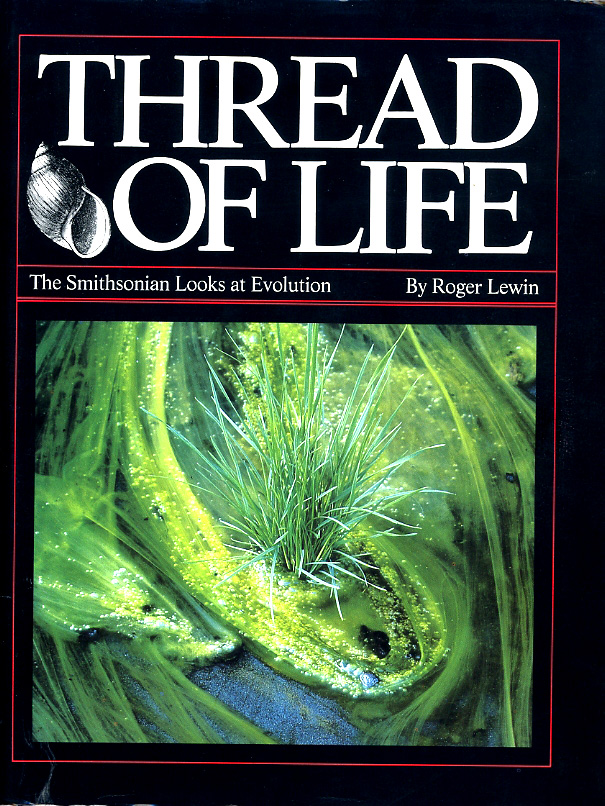
Thread of Life
Book of the Week: 26 December 2011
Now on Amazon
There are three million species of living things in the world, at least as of 1982, when Roger Lewin published Thread of Life. Lewin is an anthropologist and author of 20 books, many of which relate to evolution, including human evolution. I first encountered Lewin’s name from creationists who have frequently quoted something he has written, often out of context. The creationists want to convince people that somebody with scientific prestige is saying something bad about evolution.
At his lectures creationist Don Patton often hands out quote from serious scientist to give the impression there is disarray amongst the evolutionists’ ranks. Here is one from a page bearing the copyright of the Northside Church of Christ.
“SIMILAR” NOT NECESSARILY “KIN” – RELATIONSHIPS IMPOSSIBLE TO PROVE
BASIS OF “FAMILY TREE”. ROGER LEWIN, Editor, Research News, Science, “The key issue is the ability correctly to infer a genetic relationship between two species on the basis of a similarity in appearance, at gross and detailed levels of anatomy. Sometimes this approach….can be deceptive, partly because similarity does not necessarily imply an identical genetic heritage: a shark (which is a fish) and a porpoise (which is a mammal) look similar…, BONES OF CONTENTION, 1987, p. 123
A quick check of Bones of Contention provides the full context.
For a scientist brought up in a tradition in which the lumps and bumps on a fossil are considered the only key to the past, this was a dramatic statement, and it goes to the heart of the battle that was fought over Ramapithecus. “Morphology seemed more logical than molecules,”47 says Adrienne Zihlman. “Morphology is what we ‘see’ in the sizes and shapes of bones and teeth…and it has always been given more weight. Paleontologists have always assumed that chimpanzees and gorillas were more closely related to each other than to humans, because they look so much alike.” The key issue is the ability correctly to infer a genetic relationship between two species on the basis of a similarity in appearance, at gross and detailed levels of anatomy. Sometimes this approach works, but sometimes it can be deceptive, partly because similarity of structure does not necessarily imply an identical genetic heritage: a shark (which is a fish) and a porpoise (which is a mammal) look similar because they have become adapted to the same environment, not because they are close cousins.
Lewin notes that basing kinship on similarity is unreliable (and maybe unwarranted). Patton takes the meaning a step further and asserts that relationships are impossible to prove.
When you adopt a high profile in science for the general public like Roger Lewin has you can expect this kind of attention from the creationists.
In Thread of Life Lewin takes the reader from the putative origin of life in the ocean to the flowering of human civilization. Along the way there are many indictments of the creationists’ distortions of modern science. The history of mass extinctions evident in the fossil record is tied to findings of modern geology. The new science of plate tectonics, coupled with exhaustive geological research give powerful clues to the forces that have shaped the present biological world.
The development of the mammalian ear is seen to be the driving force behind the development of the mammalian jaw from its ancestral reptilian jaw. The fossil evidence for this puts the lie to creationists’ (including Phillip Johnson) contention that stepwise development of complex body plans is never revealed in the fossil record.
Lewin deals beautifully with the sweep of biological history, from its beginnings in the sea, the emergence of divergent body forms in the Cambrian to the development of fishes and their amphibian descendents and reptiles. Plants preceded animals on the land, and the proliferation of insect forms helped drive the divergence of plant life in a relationship that is sometimes adversarial and sometimes symbiotic. Mammals derived from an early reptilian form and missed out on the dinosaur boom and bust. These stories and more will delight the interested reader.
Hardly a page does not carry a stunning photograph or illustration. The book displays human scientists easing back the curtain of uncertainty to reveal the underlying truth. A skeptic of the creationists’ claims will appreciate the glaring comparison with the intellectually barren work of this anti-science faction of our society.
A 1992 paperback edition of Thread of Life is available through Amazon. The hardcover edition is best if it’s a coffee table copy you want. See the links.
References:
Thread of Life is available from Amazon.
http://www.amazon.com/exec/obidos/ASIN/0895990296/thenorthtexasske
Bones of Contention is available from Amazon
http://www.amazon.com/exec/obidos/ASIN/0226476510/thenorthtexasske
The referenced page of Don Patton quotes is on-line here.
http://www.ntskeptics.org/creationism/patton/dp-fossi.htm
You can review Bones of Contention through Google Books.